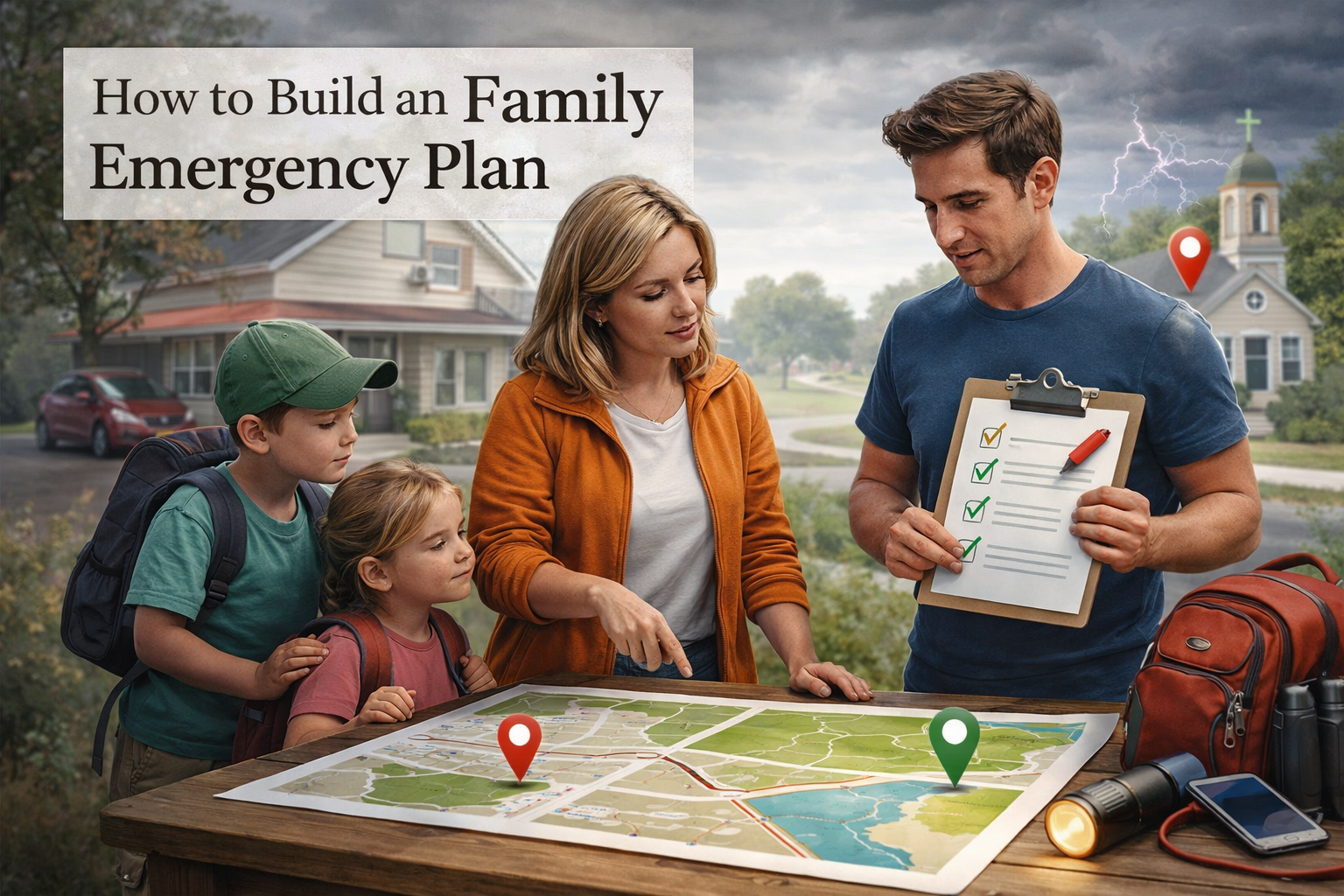
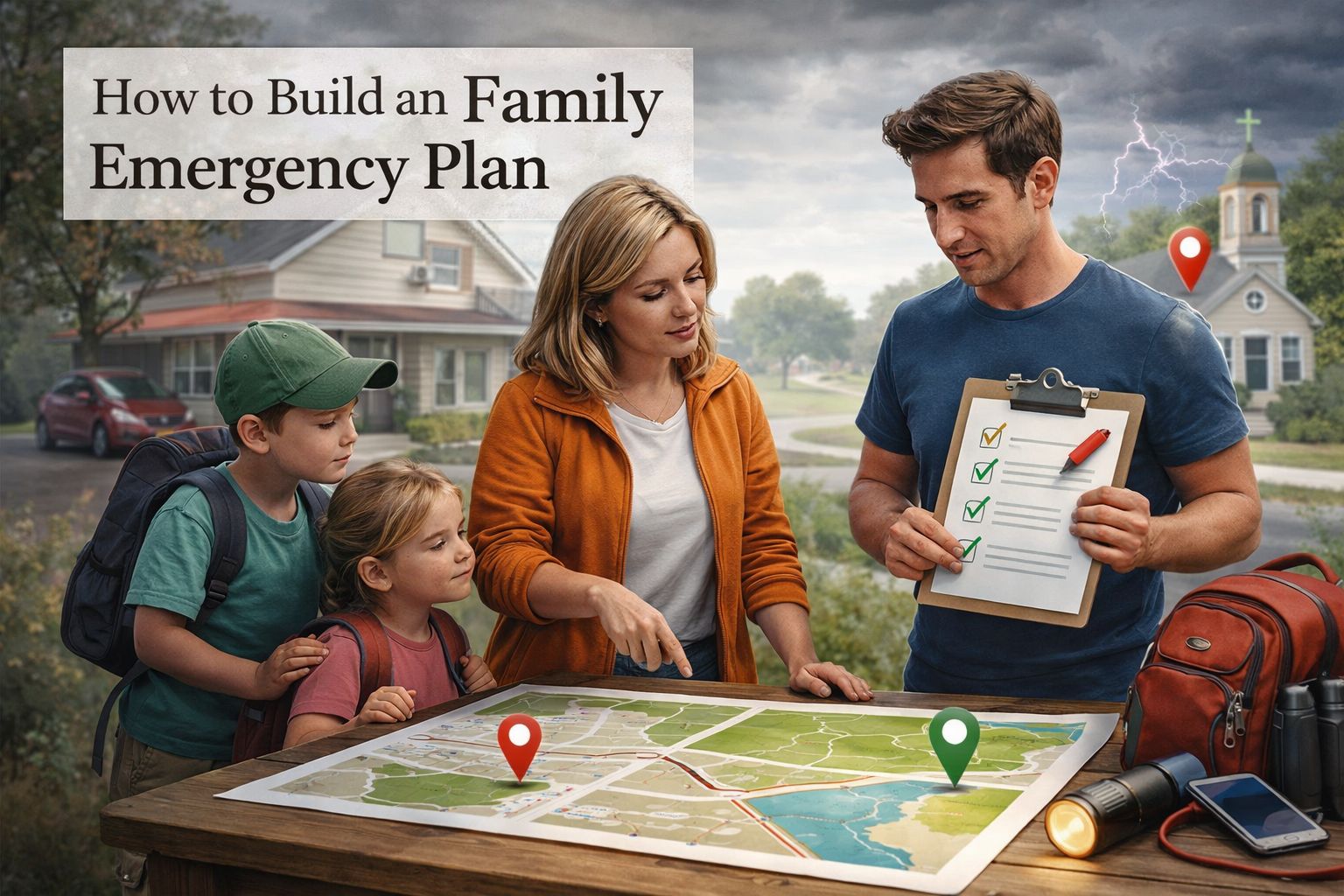
How to Build a Family Emergency Plan in One Hour
Four simple decisions that remove hesitation when emergencies happen

Dean Olson
April 02, 2026
I'm a planner by nature.
The kind of person who likes decisions made, things thought through, calendars that work.
My need for structure is so strong that I even plan time to be spontaneous. Which, yes, I realize defeats the entire point.
Not everyone is wired this way, and honestly, that's fine. Some people adapt on the fly. They figure things out as they go. That's a real strength when plans fall apart.
Because they will.
Here's what I've learned: preparedness needs both.
You need a simple plan so you're not deciding everything under stress. And you need flexibility to adjust when reality doesn't cooperate.
The problem is most families don't have a simple plan, and they don't have practice adjusting when things change.
Not because they don't care. Because no one has shown them how simple it actually is.
Most emergency planning advice makes this harder than it needs to be. Binders. Forms. Scenarios for every possible disaster. Who has time for that?
You don't need a comprehensive disaster response manual.
You need answers to four questions that remove hesitation when everything feels urgent.
This takes one hour. And once it's done, it's done.
The Real Problem
This isn't about building a perfect plan.
It's about removing the moment where everyone stands around asking, "What do we do?"
In a normal day, we assume phones work, we'll be together, and roads are open.
In a disruption, those assumptions break immediately.
Now you're not asking: "What should we do?"
You're asking: "What did we already decide?"
That's the difference between hesitation and action.
The Four Decisions That Matter
You don't need a comprehensive emergency manual. You need answers to four questions that remove hesitation when everything feels urgent.
Here's what you're deciding in the next hour:
Where do we meet if we're separated?
Who do we contact when local calls don't work?
What does each person do in the first five minutes?
What do our kids need to know?
That's it. Four decisions. One hour. Then you're done.
1. Where Do We Meet If We're Separated?
The first question every family emergency plan needs to answer: If we can't reach each other, where do we go?
Why This Matters
Cell service often fails or becomes overloaded during emergencies
Family members may be in different locations (work, school, errands)
Waiting at home might not be safe or possible
Without a pre-decided location, everyone guesses and ends up in different places
Kids especially need a clear, simple answer they can remember
Practical Action
Choose two meeting locations:
Location 1: Close to home
Within walking distance
Visible and easy to identify
Accessible even if your street is blocked
Examples:
Mailbox at the end of your driveway
Neighbor's front porch (with their permission)
Park entrance one block away
Church parking lot three streets over
Location 2: Outside your neighborhood
Far enough to avoid local road closures or evacuation zones
Familiar to everyone in the family
A place you can reach from multiple routes
Examples:
Relative's home in another part of town
Your workplace
A specific parking lot at a shopping center everyone knows
Library or community center
Decision rule:
If the emergency is localized (house fire, gas leak), go to Location 1
If the emergency affects your whole neighborhood (evacuation, major storm), go to Location 2
Write both locations down. Make sure every family member can name them without looking.
2. Who Do We Contact When Phones Work (But Not Perfectly)?
During emergencies, local calls often fail while long-distance calls go through.
Why This Matters
Local cell towers get overloaded when everyone tries to call at once
Long-distance calls route through different systems and often work
Texting uses less bandwidth and may work when calls don't
An out-of-state contact can relay messages between family members who can't reach each other directly
Kids need one simple number they can call if they can't reach parents
Practical Action
Choose one out-of-state contact person:
Requirements:
Lives outside your region (different state is ideal)
Reliable and always answers their phone
Willing to serve as your family's message hub
Has contact information for all family members
Tell them:
"You're our emergency contact. If we can't reach each other during a disruption, we'll all call you to check in and coordinate."
Give them your family's meeting locations
Make sure they have everyone's cell numbers
Program this number into every family member's phone with a clear label: "EMERGENCY CONTACT - [Name]"
For kids: Make sure they can recite this number from memory. Practice it like you practiced your home address when they were younger.
3. What Does Each Person Do in the First Five Minutes?
Confusion happens when everyone tries to help but no one knows what they're responsible for.
Why This Matters
Time matters during evacuations or immediate emergencies
Without assigned roles, people duplicate effort or freeze
Clear responsibilities remove decision-making under stress
Kids feel less scared when they know their specific job
You avoid the "What should I be doing?" question when you need to move fast
Practical Action
Assign simple, specific roles for different scenarios:
Immediate evacuation (fire, gas leak - under 5 minutes):
Adult 1: Get kids out immediately
Adult 2: Grab pets if safe
Kids: Exit and go directly to meeting spot (no going back inside)
No one retrieves anything—people and pets only
Planned evacuation (storm, wildfire - 30+ minutes warning):
Adult 1: Load vehicle and manage departure
Adult 2: Gather documents, medications, and essentials
Older kids: Help with pets (carriers, food, leashes)
Younger kids: Pack their own bag (clothes, comfort items)
Shelter in place (tornado, severe weather):
Adult 1: Get kids to safe location
Adult 2: Grab pets and bring to shelter
Everyone: Bring phones, flashlight, shoes
Move immediately—no time for extras
Key principle: Keep roles simple enough that you don't need to reference them.
Write down roles for your specific household. Review once when you create the plan, then once per year.
4. What Do Kids Need to Know?
Your plan doesn't work if your kids don't know it.
Why This Matters
Kids may be at school, daycare, or with other adults when emergencies happen
They need to know what to do without parental guidance in that moment
Fear and confusion make it hard to think clearly
Pre-decided answers reduce anxiety and improve response
Age-appropriate preparation builds confidence without creating worry
Practical Action
Information every child should know:
Ages 5-8:
Parents' full names (not just "Mom" and "Dad")
Home address
One parent's phone number memorized
Out-of-state emergency contact name and number
Family meeting location #1 (the close one)
Ages 9-12 (add to above):
Both parents' phone numbers
Family meeting location #2 (the outside-neighborhood one)
Basic "if you can't reach us, call [emergency contact]" protocol
Ages 13+ (add to above):
Full emergency plan (meeting locations, roles, contact info)
How to check in via text if calls don't work
Decision rule for which meeting location to use
How to teach this without creating anxiety:
Don't frame it as "in case something bad happens."
Frame it as: "Our family has a plan so we always know how to find each other. Here's what you need to know."
Practice the information casually:
"What's our meeting spot if we get separated at the store?"
"Who's our out-of-state contact person?"
"What's my phone number?"
Make it normal, not scary.
For school-age kids:
Confirm the school's emergency procedures
Know who can pick them up (authorized list on file)
Understand that if you can't get there immediately, the school will keep them safe
Have a plan for who picks them up if both parents are unavailable
Write It Down (One Page, Five Minutes)
You've made the decisions. Now make them permanent.
What to include:
Meeting Locations:
Location 1 (close): [Address or description]
Location 2 (outside neighborhood): [Address]
Emergency Contact:
Name: [Out-of-state contact]
Phone: [Number]
Relationship: [Aunt, friend, etc.]
Family Roles:
Immediate evacuation: [Who does what]
Planned evacuation: [Who does what]
Shelter in place: [Who does what]
Kids' Information to Memorize:
[List what each child needs to know by age]
Store this plan in three places:
Photo on every adult's phone
Paper copy in your document bag
Shared digital file (Google Drive, family group chat)
This takes five minutes. Do it now before you close this article.
Do This Today
Here's your one-hour timeline:
Minutes 1-15: Choose your two meeting locations. Text them to your household right now.
Minutes 16-25: Pick your out-of-state contact. Call them and explain their role. Get confirmation.
Minutes 26-40: Assign roles for different scenarios. Write them down.
Minutes 41-50: Identify what your kids need to know. Start teaching it this week.
Minutes 51-60: Write the one-page plan. Take photos. Share with family.
Done.
You now have a plan that 95% of households don't have.
And it's not because you did something complicated. It's because you made four simple decisions when you had time to think clearly.
The Real Shift
The mistake isn't lacking a plan.
It's assuming you'll figure it out in the moment.
You won't. None of us will. Stress narrows thinking. Confusion spreads fast.
Instead of asking: "Do we have a plan?"
Ask: "If we were separated right now, would we know where to go and who to call?"
That's the standard.
Get Your Personalized Next Steps
A family emergency plan is universal. Every household needs one.
But your next preparedness priorities after this depend on your specific situation—your location, your household composition, your medical needs, your constraints.
The PrepareRight assessment identifies your top 10 priorities, ranked specifically for your circumstances.
It takes 3 minutes and tells you exactly what matters most for your household.
Start with a plan. Then build from there.
One right step at a time.
Prepare one right step at a time.
Want to Know Your Top 3 Priorities?
Every household is different. Your location, family size, medical needs, and current preparedness level all affect what you should focus on next.
I built a free assessment that asks about your specific situation and gives you your personalized top 3 priorities—not a generic list, but recommendations tailored to your household.
Prepare one right step at a time.