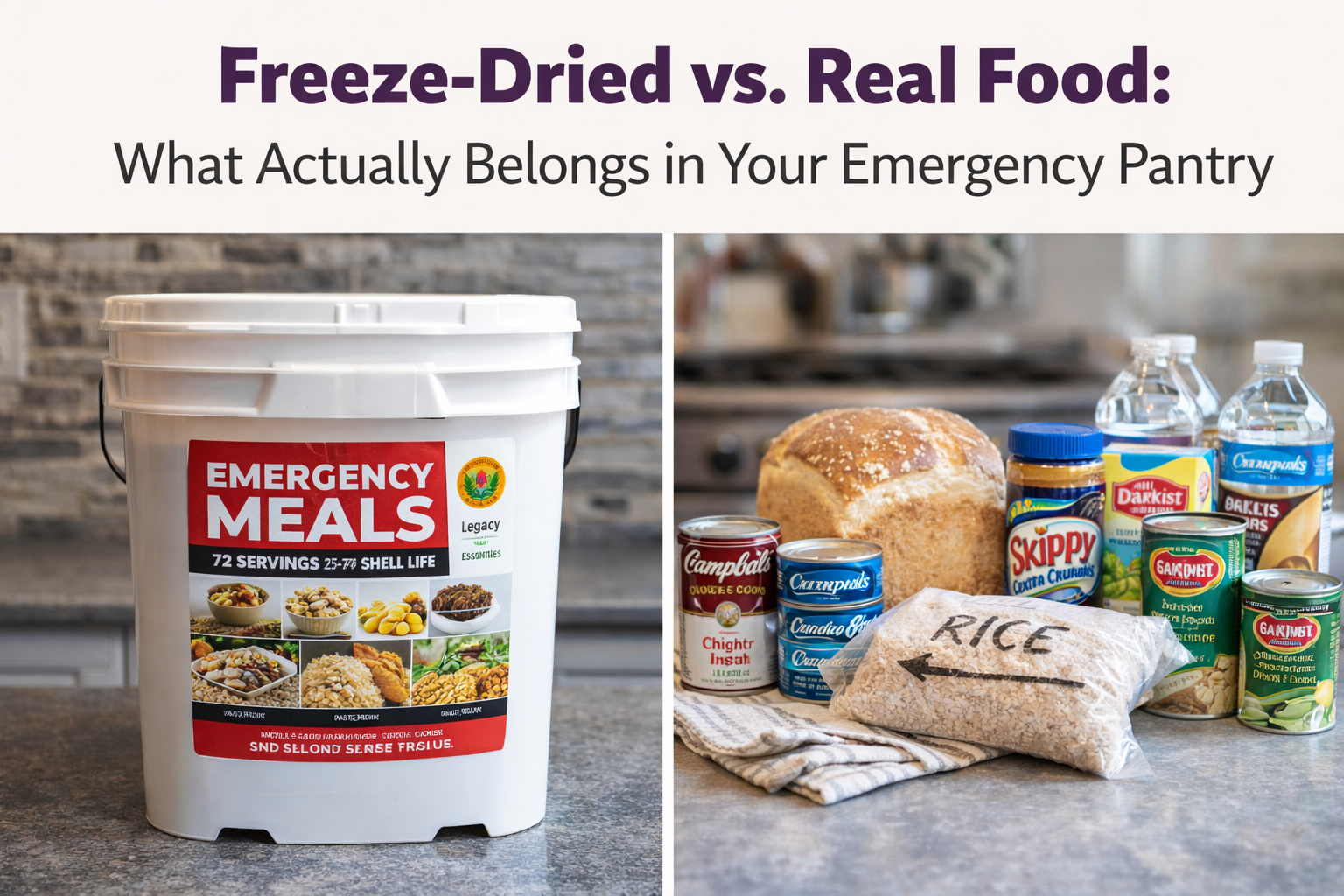
Freeze-Dried vs. Real Food: What Actually Belongs in Your Emergency Pantry
The emergency food bucket looks like the right answer. For most families, it isn't.

Dean Olson
March 05, 2026

You're walking through Costco and you see it: a 72-serving bucket of freeze-dried emergency meals stacked near the exit. Mountain House. Legacy Food Storage. Enough calories for two weeks of disruption, right there on a pallet next to the paper towels.
It feels like a responsible purchase. It's designed to feel that way.
But before you put it in the cart, it's worth asking an honest question: is freeze-dried food actually the right first move for most families — or does that money work harder somewhere else in the store?
I've thought about this more than I'd like to admit. I've compared shelf lives, calculated calories per dollar, and read more reviews of emergency food buckets than any reasonable person should. Here's what I've had to acknowledge: for most households facing most realistic disruptions, a cart full of familiar groceries outperforms a bucket of freeze-dried meals every time.
Not because freeze-dried food is bad. It isn't. But because sequence matters, and most families haven't covered the basics that come before it.
The emergencies most households face aren't 90-day grid-down scenarios. They're a winter storm that closes roads for three days. A power outage that stretches past 48 hours. A brief job disruption that tightens the grocery budget. A hurricane evacuation with two days' notice.
In those moments, the household that opens a familiar pantry and cooks a normal dinner is more prepared than the one staring at instructions for reconstituting scrambled eggs no one has ever tasted.
Why Freeze-Dried Food Feels Like the Right Answer
There's a reason those buckets sell.
Freeze-dried food has a 25-year shelf life, requires no rotation, and comes with exact calorie counts. It feels serious. It feels complete. You buy it once, put it in the garage, and feel like you've handled something.
The problem is what happens next.
The bucket sits untouched for years. Your family has never eaten those meals. When you actually need it — during a real disruption, under real stress — your kids refuse it, you can't remember where you stored the water needed to reconstitute it, and the portable stove you planned to use is buried behind the holiday decorations.
Freeze-dried food solves a problem that most households won't face for years, if ever, while leaving unsolved the disruptions that happen regularly.
A well-stocked pantry of food your family already eats solves this week's snowstorm. It covers a 48-hour power outage. It handles two weeks of budget pressure after an unexpected expense. It works every time because it's already part of daily life.
Preparedness works when it integrates into how you actually live. When it's separate from daily life, it gets neglected.
What $200 in Regular Groceries Actually Buys You
A single warehouse store run can realistically cover five to seven days of normal meals for most families. Not survival rations. Real food your household already eats, in quantities that create a genuine buffer.
The basics: a large bag of rice, dry beans or lentils, pasta, oats, and potatoes give you a calorie foundation. Add canned proteins — chicken, tuna, beans — plus peanut butter and shelf-stable milk, and you have the building blocks for complete meals. Layer in canned soups, chili, and ready-to-eat options for the moments when the power is out and convenience matters. Add bottled water and a few familiar comfort foods. Stress compounds during disruptions. A normal cup of coffee matters more than people admit.
For $200 to $250, you have a food supply your family will actually use, that requires no special preparation, and that quietly reduces risk every single week — not just during emergencies.
Compare that to a 72-serving freeze-dried bucket at the same price point. You get meals your family has never tried, preparation that requires hot water and a heat source, and food that won't see daylight for years.
The math on shelf life favors the bucket. The math on actual usefulness favors the pantry.
1. Build From What You Already Eat
The principle that makes a pantry buffer work — and that freeze-dried food planning skips entirely — is familiarity.
Families don't eat well under stress when the food is foreign. Children especially. An emergency is not the moment to introduce freeze-dried scrambled eggs to a seven-year-old who eats approximately four foods on a good day.
Why this matters:
Familiar food reduces stress in an already stressful situation
Your family's dietary needs and preferences are already built in
No learning curve on preparation when clarity matters most
Food you already enjoy gets eaten and naturally rotates itself
Practical action:
Walk your pantry and note what your family eats most reliably
Build your emergency buffer around those same foods in larger quantities
Add shelf-stable versions of staples you use weekly — canned beans instead of fresh, shelf-stable milk instead of refrigerated
Aim for five to seven days of complete meals, not a random assortment of individual items
The right gear: A set of food-grade storage containers (OXO or similar) keeps bulk dry goods organized and clearly labeled. About $30, and worth it when you're searching for the pasta at 10pm during a power outage.
2. Solve the Rotation Problem
Buying emergency food and having usable emergency food are two different things — and this is where five-gallon buckets of beans and rice fail most households.
The bucket doesn't remind you it exists. You buy it, store it, and forget about it. When you eventually open it — during an actual emergency or just while cleaning the garage three years later — the contents are fine technically, but your family still won't eat unfamiliar food under stress, and the bucket has done nothing to reduce the friction of the past three years of ordinary disruptions.
A pantry buffer, by contrast, rotates naturally through daily life.
Why this matters:
Food that doesn't rotate eventually becomes waste or psychological clutter, not preparedness
Expiration dates on shelf-stable food are real — canned goods typically last two to five years
A static stash requires active management most households won't sustain
A rolling buffer requires no discipline beyond normal grocery habits
Practical action:
Keep two of everything instead of one — two cans of chicken, two jars of peanut butter, two bags of rice
When you open one, replace it on your next grocery run
Put new purchases behind older stock so older items get used first
Set a calendar reminder once per year to check dates and donate anything approaching expiration
This system doesn't require a spreadsheet or dedicated storage room. It requires about three extra minutes at the grocery store each week.
When Freeze-Dried Food Actually Makes Sense
This isn't an argument against freeze-dried food. It's an argument for sequencing.
There are households for whom long-term freeze-dried storage makes genuine sense: remote locations with limited resupply access, households with extended evacuation risk, or families who have already built a solid pantry buffer and want a deeper secondary layer.
For those households, a freeze-dried supply is a smart addition to a solid foundation.
The problem is that most people buy the bucket first — before the pantry buffer, before the water supply, before the basic systems that cover the disruptions that actually happen. They skip step one and jump to step seven because step seven comes in a satisfying container with a 25-year shelf life printed on the side.
Get the foundation right first. The freeze-dried food can wait.
From Food Security to Your Household's Real Gaps
A well-stocked pantry handles a lot: snowstorms, power outages, short-term budget pressure, brief supply disruptions. It's one of the highest-return preparedness steps any household can take.
But it's one layer of a larger picture.
Once you've covered food security, the next priorities vary significantly by household. A family in Florida with elderly parents has completely different gaps than a young couple in a northern climate. Medical needs, housing type, water source, and heat source all shift what matters most.
Generic lists can't account for that.
Instead of asking: "Should I buy the freeze-dried bucket?"
Ask: "What is the most likely gap in my household right now?"
That answer is different for every family.
If you want help identifying your household's personalized priorities — food, water, power, medical, financial — I built a free preparedness assessment.
It takes a few minutes and gives you your top 10 steps ranked specifically for your situation.
👉 Take the free assessment at PrepareRight.co
Preparedness is not about doing everything.
It's about doing the right next thing.
Prepare one right step at a time.

Want to Know Your Top 3 Priorities?
Every household is different. Your location, family size, medical needs, and current preparedness level all affect what you should focus on next.
I built a free assessment that asks about your specific situation and gives you your personalized top 3 priorities—not a generic list, but recommendations tailored to your household.
Prepare one right step at a time.