New post

Dean Olson
March 19, 2026
The Documents You Can't Evacuate Without

The Documents You Can't Evacuate Without
When we adopted our daughter, we didn't have a choice about getting organized.
We had to gather everything: certified birth certificates, marriage license, driver's licenses, fingerprinting records, home studies. It all had to be in one place, organized, accessible.
The file was massive. Intimidating, honestly.
But once we had everything compiled, something unexpected happened: maintaining it became simple. When a document expired or needed updating, we just swapped it out. The hard part was the initial collection, not the upkeep.
Most preparedness conversations focus on what you can grab during evacuations.
Gear. Supplies. Equipment.
But the thing that actually stops families isn't missing a flashlight. It's missing proof they exist.
I learned this lesson again when my parents passed. As executor, I spent hours hunting for the documents needed to settle their estate—bank statements, investment records, funeral plans, insurance policies. Hours I didn't have, during a time when I couldn't think clearly.
I keep those same documents organized now. Not for me—for my family, so they don't face that search when I'm gone.
And here's what surprised me: the file I maintain now is much smaller than that adoption binder ever was. The necessary documents fit in a single portable bag. The intimidating part isn't the volume—it's the decision to actually gather them.
The Real Problem
This isn't about whether you have documents.
It's about whether you can access them when stress is high and time is short.
In a normal week, scattered works fine. We know where things are—roughly:
A drawer for IDs. A folder for insurance. Email for bills. A safe for "important stuff."
In a disruption, that system breaks immediately.
You don't get time to hunt. You don't get clarity to remember. And if you're not the one looking—if it's your spouse, your adult child, or a trusted friend trying to help—they have no idea where anything is.
What Actually Happens During Real Emergencies
Most situations are fast and inconvenient, not dramatic:
A house fire starts in the middle of the night. A wildfire evacuation order comes with 30 minutes' notice. A medical emergency puts you in the hospital unexpectedly. A storm forces you out before you're ready.
You're leaving quickly.
And suddenly the question isn't: Do we have this?
It's: Can we grab it right now?
The families that struggle most aren't missing documents. They're missing access.
The Documents You Actually Need
The critical documents fall into five categories. That's it.
You don't need everything you own. You need the documents that let you function immediately after displacement.
1. Identification Documents
You can't do anything without proving who you are.
Why This Matters:
Everything else—lodging, financial access, medical care—depends on identification
Required for travel, hotel check-in, and accessing bank accounts
Replacement can take weeks if originals are lost
Children need identification for school enrollment and medical care
What to Gather:
Driver's licenses or state IDs (copies for each adult)
Passports (originals if you have them)
Social Security cards (secure copies)
Birth certificates for all household members
Marriage certificate or divorce decrees if applicable
2. Insurance Documents
This is your financial recovery system.
Why This Matters:
Claims require policy numbers and contact information immediately
Delays in filing can cost you coverage
You need proof of insurance before temporary housing is approved
Insurance companies need specifics you won't remember under stress
What to Gather:
Homeowners or renters insurance policy (copy with policy number visible)
Auto insurance cards or policy summary
Health insurance cards for all family members
Life insurance policies
One-page summary with all policy numbers and claim contact info
3. Medical Information
Medical issues often overlap with emergencies.
Why This Matters:
You may not be able to communicate clearly in the moment
Medication names and dosages aren't things we memorize perfectly
Allergies and conditions need to be communicated accurately
Medical history affects treatment decisions
What to Gather:
Current medication list with dosages
Allergy list for each family member
Chronic conditions or past surgeries
Primary care physician and specialist contact information
Health insurance cards and policy details
Copies of advance directives or healthcare proxies
4. Financial Access Documents
You'll need money immediately, and disruptions don't pause your bills.
Why This Matters:
Account recovery without information can take days or weeks
You need funds quickly for temporary housing or supplies
Autopay failures can cascade into credit problems
Financial institutions require verification before granting access
What to Gather:
List of bank accounts with institution names and account numbers
Credit card summary (issuers and contact numbers)
Emergency cash ($200+ in small bills, stored separately)
Recent bank statements for proof of account ownership
Contact information for all financial institutions
5. Legal Documents
These determine who can act on your behalf when you can't.
Why This Matters:
Medical decisions may need to be made when you're incapacitated
Financial institutions won't allow access without proper authorization
Minor children need designated guardians if something happens to parents
Without these documents, courts make decisions for you
What to Gather:
Will (current version)
Power of attorney (financial and healthcare)
Healthcare directive or living will
Guardianship designations for minor children
Trust documents if applicable
How to Store Everything
You need two systems: physical and digital.
Physical Storage
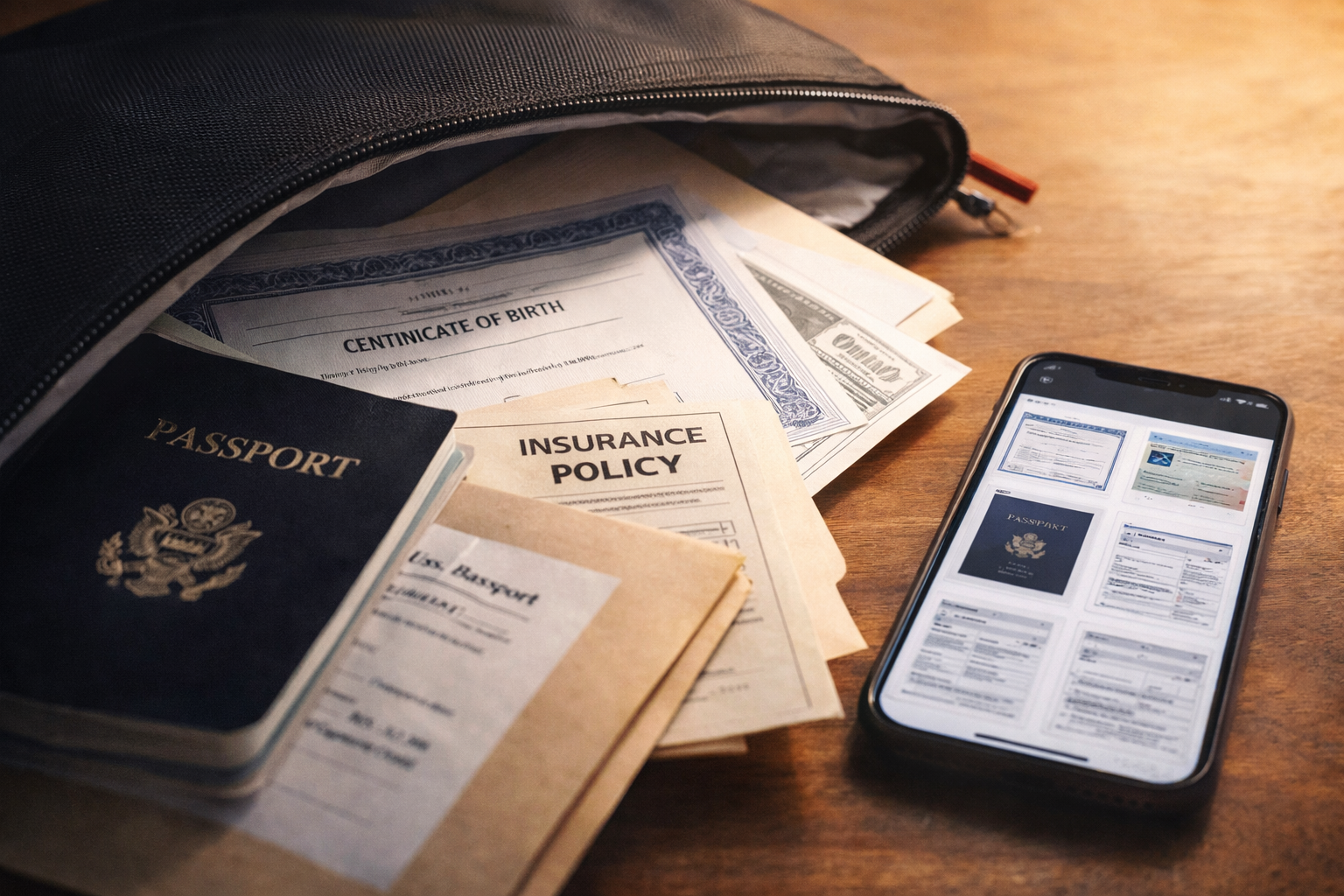
Use a fireproof, waterproof document bag or small safe. Store all critical documents in one location. Keep it easily accessible—not buried in a closet or basement. Make sure at least one other adult knows where it is.
WHAT TO BUY:
Looking for: fireproof waterproof document bag safe
Shop on Amazon →
Digital Backup
Scan all critical documents. Upload to Google Drive, Dropbox, or similar cloud service. Organize into clearly labeled folders (Insurance, Medical, Legal, Financial, IDs). Ensure you can log in from your phone. Test this.
Consider sharing folder access with a trusted spouse or family member. Use strong passwords and two-factor authentication.
Do This Now
Here's what makes this manageable: you don't need to do it all at once.
This week:
Gather identification documents. This takes 20 minutes. Put them in one envelope. That's progress.
Next week:
Add insurance documents. Pull your policy info. Add it to the envelope.
Week three:
Medical information. Write down medications and allergies. Add it.
You're not building a filing system. You're collecting what you'd need if you had to leave in 30 minutes.
The initial gathering feels big. Maintaining it is simple—just swap out documents when they update.
The file you end up with is smaller than you expect. What feels intimidating isn't the volume. It's starting.
Get Your Personalized Assessment
Document access is universal. Every household needs it.
But the specific gaps in your preparation depend on your situation—your location, your family composition, your medical needs, your housing type.
I built a free assessment that identifies your top 10 preparedness priorities, ranked specifically for your household.
It takes 3 minutes and tells you what matters most for your circumstances.
Start with documents. Then build from there.
Prepare one right step at a time.
Want to Know Your Top 3 Priorities?
Every household is different. Your location, family size, medical needs, and current preparedness level all affect what you should focus on next.
I built a free assessment that asks about your specific situation and gives you your personalized top 3 priorities—not a generic list, but recommendations tailored to your household.
Prepare one right step at a time.