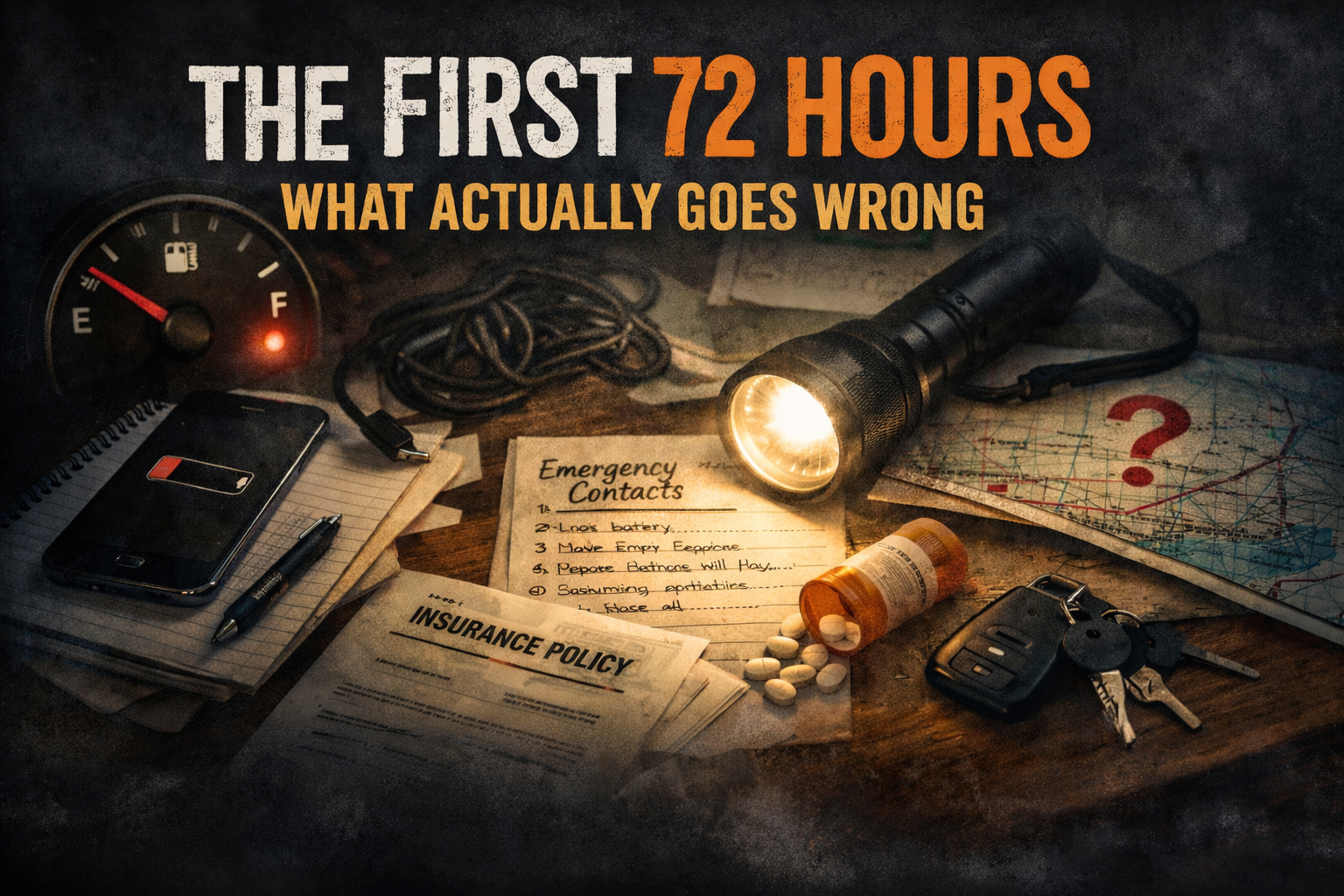
The First 72 Hours: What Actually Goes Wrong
Emergencies rarely fail because of collapse. They fail because of confusion, access gaps, and small decisions under stress.

Dean Olson
February 19, 2026
The First 72 Hours: What Actually Goes Wrong After Emergencies

Most people think they know what an emergency looks like.
Power goes out. Roads close. Stores run empty. Systems fail.
That part is usually true.
What catches people off guard isn't the disruption itself. It's what happens next.
The confusion. The small decisions that suddenly feel heavy. The realization that having supplies and knowing where they are are two different things.
I've watched this pattern play out across different communities during different emergencies. The details change. The confusion doesn't.
Families with generators spend the first hour trying to remember how to start them. Parents with emergency plans realize their kids don't actually know what those plans are. Households with food storage can't find the manual can opener.
The first 72 hours after real emergencies aren't dramatic. They're disorganized.
And disorganization causes more immediate harm than the emergency itself.
We prepare for scenarios. We should be preparing for gaps. Major disruptions do happen, and long-term planning matters. But the first 72 hours aren't usually about collapse. They're about the gap between normal life and functioning under stress.
That gap is wider than most of us expect.
What Actually Fails First
Across communities, after real disruptions, the same issues show up over and over.
Not collapse. Not lawlessness. Not wilderness survival.
The real failures are predictable and mundane:
No one knows where critical documents are.
Phones die and charging plans were never discussed.
Fuel runs low faster than expected.
Prescriptions are almost empty.
Kids are unsure what to do or where to meet.
Basic communication breaks down.
Decision fatigue sets in quickly.
None of this makes for compelling content. All of it makes for a long three days.
We can spend hours debating whether freeze-dried meals beat canned goods. We don't spend 20 minutes deciding where to meet if cell service fails during a school day. Priorities might be backwards.
1. Access Breaks Before Supplies Do
Most households have more supplies than they realize. What we don't have is organized access.
In the first 24 hours after disruption, we're not asking, "Do we have a tactical solution?"
We're asking:
Where is the insurance information?
Who has the account passwords?
How do we contact relatives if cell towers are overloaded?
Which breaker controls the freezer?
A flashlight in the wrong drawer is almost as useless as no flashlight at all.
Why This Matters
Delays compound stress and narrow thinking
Stress leads to avoidable mistakes
Small access problems grow when clarity is missing
Time spent searching is time not spent solving
Organization prevents panic from turning into crisis
Practical Action
Identify one central location for essential documents
Make sure at least one other adult knows where it is
Walk through basic home systems together (breaker panel, water shutoff, gas valve)
Charge external battery packs once per month
Label critical items so anyone can find them
This is not glamorous work. It is effective work.
2. Decision Fatigue Hits Fast
Emergencies compress time. Even routine disruptions require dozens of small decisions.
Should we leave? Should we stay? What do we take? Who calls who? Is this serious or temporary?
Without pre-decisions, every choice feels urgent and heavy.
During one regional evacuation order, neighbors debate for hours whether they should leave. Not because they don't care—but because they've never discussed the threshold for action.
Preparedness without pre-decisions becomes expensive chaos.
Why This Matters
Stress reduces cognitive bandwidth dramatically
We default to avoidance when overwhelmed
Disagreement between household members slows action
Delayed decisions can close options entirely
Clarity matters more than gear in the first 72 hours
Practical Action
Decide in advance what triggers evacuation for your household
Identify one meeting location if separated
Assign roles (who gathers documents, who manages pets, who contacts family)
Write it down in one page and keep it simple
Review it once per year with everyone present
You don't need a binder. You need agreement.
3. Mobility and Margin Shrink Quickly
Evacuations, storms, and regional disruptions often create fuel shortages and traffic delays within hours.
Hospitals get crowded. Gas stations run dry. ATM lines grow.
The difference between having margin and running on fumes becomes obvious fast.
Why This Matters
Infrastructure strains under surge demand
Delays extend travel time unpredictably
Stress increases consumption (fuel, food, energy)
Options disappear when margin disappears
Preparedness is about preserving choices, not preventing disasters
Practical Action
Maintain a fuel buffer (never below quarter tank)
Keep one small amount of cash accessible
Refill prescriptions before they run empty
Review vehicle maintenance schedule quarterly
Know where the closest alternate gas stations are
These habits cost little and protect much.
4. Communication Breaks Down
In most emergencies, families are not in the same place when disruption begins.
Kids are at school. Spouses are at work. Parents are traveling.
Without clear communication plans, the first 72 hours become a series of frantic messages.
Who is safe? Where are you? What is the plan?
Why This Matters
Anxiety escalates when information is unclear
Repeated calls drain batteries faster
Miscommunication creates unnecessary risk
Children especially need predictable instruction
Preparedness is emotional as much as logistical
Practical Action
Choose one out-of-area contact everyone checks in with
Make sure children know two phone numbers by memory
Decide where you meet if cell service fails
Practice the conversation once—that is enough
Keep a written copy of critical contacts
Calm is contagious when roles are clear.
The Pattern Across All of This
Notice what's missing from this list.
There are no advanced tools required. No complex gear systems. No dramatic training sequences.
The first 72 hours are dominated by access, coordination, margin, and communication.
The households that struggle most aren't the ones who lack equipment. They're the ones who never clarified the basics.
Gear doesn't fail as often as systems do. And most of us don't have systems—we have intentions.
From General Advice to Personal Priorities
These four priorities are nearly universal. Every household needs them.
But once you've covered these basics, preparedness becomes highly personal.
The fifth most important step for a family in Miami with elderly parents is completely different from a young couple in rural Montana.
Location matters. Household composition matters. Medical needs matter. Mobility matters.
Generic checklists fail because they treat everyone the same.
Instead of asking: "What should I prepare for?"
Ask: "What breaks first in my household, and what would reduce the most stress?"
That answer is different for everyone.
Prepare for the First 72 Hours—Not the Movie Version
Real emergencies are inconvenient, not cinematic.
They're dominated by small failures that stack quickly.
Preparedness isn't about imagining the most extreme scenario. It's about stabilizing the most predictable one.
If you want help identifying your household's top 10 priorities—based on your location, household structure, and current gaps—I built a free preparedness assessment.
It takes a few minutes and gives you personalized next steps ranked for your situation.
👉 Take the free assessment at PrepareRight.co
Preparedness is not about doing everything.
It's about doing the right next thing.
Prepare one right step at a time.

Want to Know Your Top 3 Priorities?
Every household is different. Your location, family size, medical needs, and current preparedness level all affect what you should focus on next.
I built a free assessment that asks about your specific situation and gives you your personalized top 3 priorities—not a generic list, but recommendations tailored to your household.
Prepare one right step at a time.